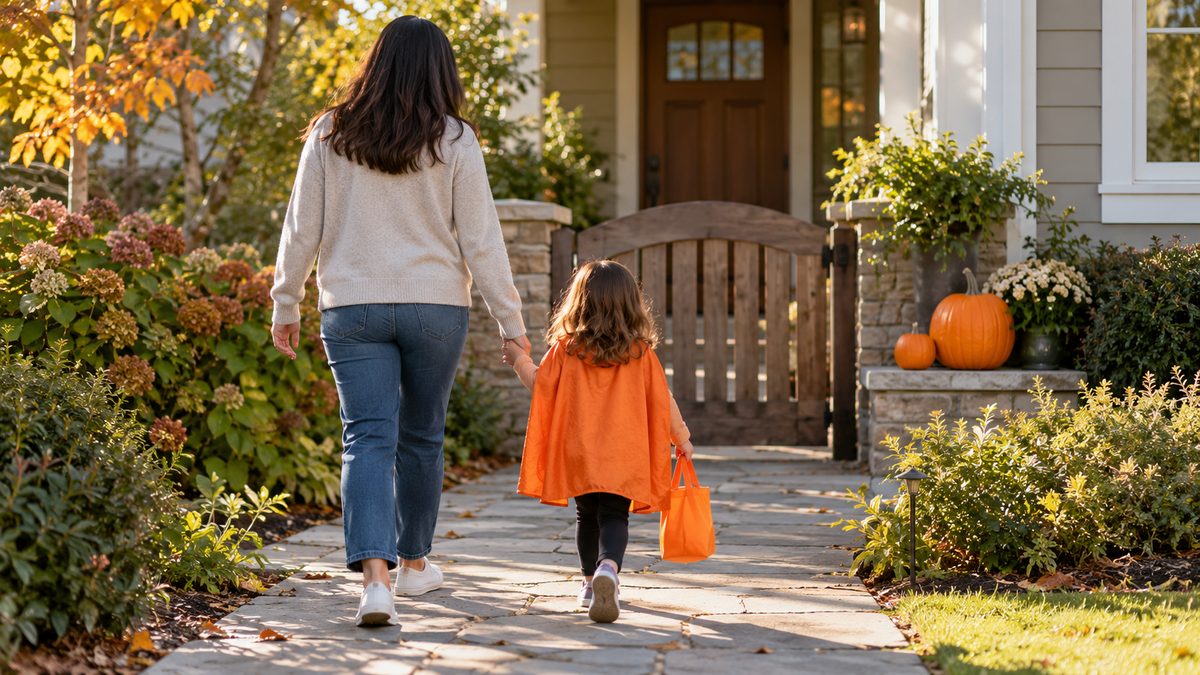
Keep trick-or-treat night manageable by choosing a short route, limiting what you carry and planning a rest before children become exhausted. If a child needs lifting, stop on level ground, bring them close and step round to turn instead of twisting under their weight.
A walk that feels easy on the way out can be harder with a tired child, a growing bag of sweets and a costume prop in your hand. Plan for the return journey while everyone is still keen to leave. There is no need to reach every decorated house.
Build the route around the journey home
Choose a loop you can shorten, with familiar paths and somewhere suitable to pause. Check steps, steep sections, uneven paving and road crossings in advance where possible. Avoid making the farthest house the point where your child usually runs out of energy.
Agree with any accompanying adult who will supervise children if someone stops, carries a bag or returns home early. Keep hands available for road crossings. A lift, phone call or transport plan is useful only if it will be available at the time you need it.
For children who still use a pushchair, consider whether the route allows it without repeated lifting over steps. Follow its instructions for age, size, seating and loads. Do not hang heavy treat bags from the handles or use the footrest as an extra passenger seat.
Try the whole costume before leaving
Ask the child to walk, turn and climb an ordinary step in the outfit while supervised. Look for trailing hems, restricted movement and footwear that slips. A short test at home is easier than altering a costume beside a busy road.
Check your own clothing too. A long cape, loose mask or bulky accessory can interfere with looking down, gripping a child or pushing a pushchair. Put awkward props aside before any lift. Comfortable shoes with grip matter more than matching the costume; see footwear and everyday movement.
Keep outfits suited to the local weather. Halloween evenings can feel very different across the US, UK and India, so check current local conditions rather than assuming a cold night. Extra clothing should not make it difficult to hold the child securely.
Keep the sweets from becoming a second passenger
| What adds effort | Adjustment before the walk | Check during the outing |
|---|---|---|
| A large treat bucket | Start with a small, easy-to-grip container | Empty it at home rather than keep filling it |
| Several bags in one hand | Take fewer extras and share loads with another adult | Keep a hand available for supervision |
| Bulky costume props | Choose something light or leave it behind | Put it away if it catches or obstructs movement |
| Water and spare clothing | Pack only what your route needs | Return early if the combined load becomes awkward |
Keep collected sweets separate from loose clothing and personal belongings so you can offload them quickly. A bag does not need to hurt before it deserves emptying. The heavy bag guide explains why reducing the load matters alongside how you hold it.
Handle the tired-child moment before the lift
When a child asks to be carried, move out of the walking flow and away from the kerb first. Offer a seated rest if appropriate and decide whether it is time to go home. Do not start carrying merely because the next house looks close.
If a brief carry is comfortable and safe for you, put bags down or pass them to another adult. Stand close with a stable stance. Let the child know what you are about to do, bend through your hips and knees as comfortable and bring them towards you without a sudden upward pull on their arms.
Hold the child securely near your body, then move your feet to face the direction of travel. Avoid lifting while turning to answer someone or reaching across a gate. When putting the child down, stop, find stable footing and lower them in a controlled way.
A child can wriggle or fall asleep, changing how the load feels. If you need to lean back, cannot see your feet or lose a secure grip, the carry is too difficult for that situation. The advice on carrying a toddler comfortably offers further everyday adjustments.
Do not transfer a sleeping child between adults while both are walking. Stop in a safe place and agree the handover first. Avoid placing a child on your shoulders to solve fatigue when balance, visibility or grip is uncertain.
End the outing while everyone can still get home
Turn back when the first signs of tiredness appear, rather than waiting for tears or a parent struggling under several loads. Slow the pace and let children take breaks without asking them to race between doors.
Once home, put bags onto a stable surface before helping with shoes and costumes. Sit beside the child or bring the task closer instead of spending a long time bent over the floor. An earlier finish can leave enough energy for the last tasks of the evening.
Back symptoms to take seriously after the walk
This article provides general guidance. Stop carrying if pain develops, and ask a clinician about persistent pain, pain that worsens or symptoms that affect normal movement. New leg weakness, numbness or fever should not be dismissed as the result of a busy evening.
Seek emergency help for back pain with new bladder or bowel changes, reduced feeling around the genitals or bottom, or symptoms in both legs. Significant pain after a fall also needs assessment. Our back pain warning signs explains when to get medical help.
Frequently asked questions
Should I wear a costume while carrying my child?
Only if it leaves your grip, vision and movement clear. Remove bulky props and anything that trails or catches before lifting. A costume that works for walking may still make carrying awkward.
Is a backpack always better than a hand-held bag?
No bag makes a heavy load suitable. A light backpack with both straps adjusted may be convenient, but it must not interfere with supervising children or another carrying arrangement. Reduce the contents first.
What if another adult cannot come with us?
Choose a route and duration you can manage alone, with a clear early return option. Stay close to home if you cannot safely carry a tired child or manage their transport without help.
Does changing the carrying side prevent back pain?
It may vary the effort, but it does not remove the demands of carrying. If you are leaning or struggling, stop somewhere safe and change the plan rather than relying on repeated side swaps.