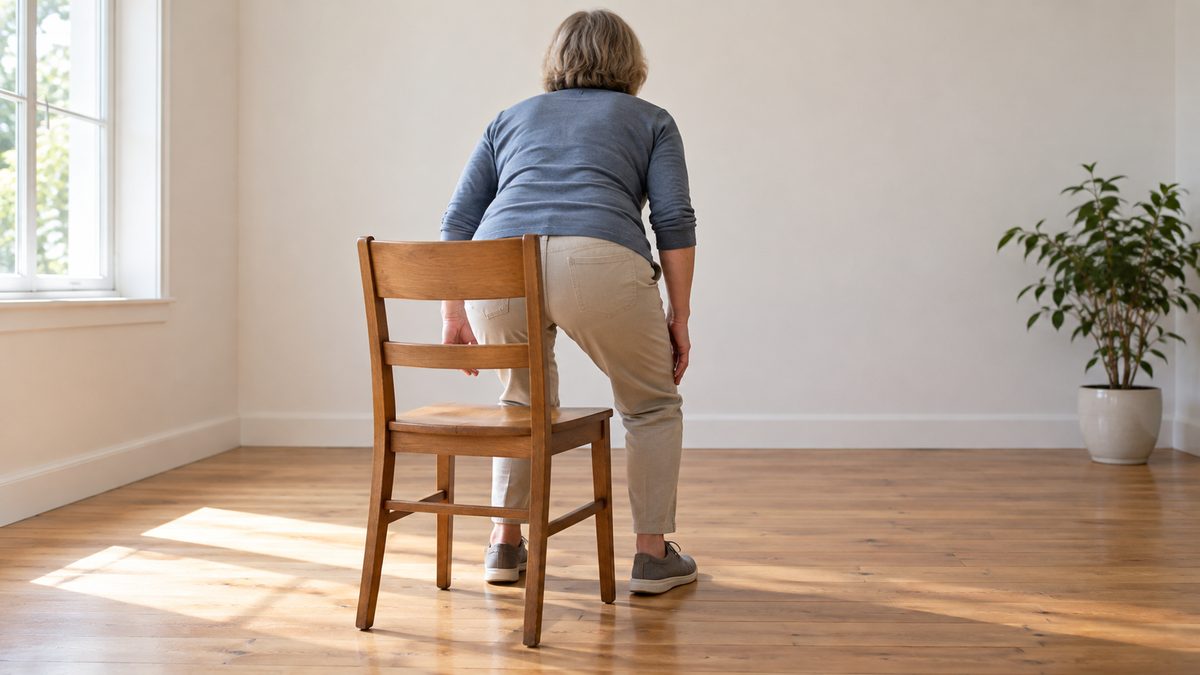
The Alexander technique teaches awareness of posture and movement in everyday activities, such as sitting down, standing up and walking. It is a learning approach rather than a treatment that forces your back straight, and evidence for benefits is limited.
Lessons may reduce back-pain-related disability and how often pain is felt, but more studies are needed. If you are considering lessons because your back hurts, first distinguish a movement-learning goal from symptoms that need medical assessment.
Learning to notice effort during ordinary tasks
The approach asks you to notice habits, such as tightening your neck before standing or holding your shoulders up while typing. A teacher helps you explore doing the task with less unnecessary effort. The purpose is not to maintain one rigid position throughout the day.
You may pause before a familiar movement, notice where you tense and try another way of approaching it. This can feel different from an exercise class because attention and choices during the task are central. It does not require you to judge every small movement as right or wrong.
For an everyday starting point, our guide to comfortable standing and sitting posture describes why appearance alone cannot show how much effort a position takes.
What you might do in a first lesson
Lessons are usually one-to-one. A teacher may begin by asking what you want to change and which activities you find difficult. You might practise standing from a chair, walking around the room or sitting at a desk while discussing what you notice.
Teaching can include spoken guidance and gentle hands-on guidance, with your agreement. You may also be invited to lie on a firm surface as part of the lesson. Ask beforehand what the session involves and say if lying down, getting up or being touched would be uncomfortable.
You should be able to decline touch or stop a movement. Explain any pain, dizziness, mobility difficulty or medical restriction before the session begins. Do not assume a teacher knows your health history from the way you stand.
There is no need to arrive with a performance-ready posture. Comfortable clothing that allows ordinary movement is more useful than trying to look straight. Bring a description of the daily task you want help with, such as reaching for a mouse or rising from a low sofa.
The back pain evidence has a narrow meaning
The NHS describes the Alexander technique as teaching better posture and movement. Its account says lessons may reduce back-pain-related disability and how often pain is felt, while also recognising that the evidence is limited and more research is needed.
A GP-practice study involving over 500 people with chronic back pain found that one-to-one Alexander lessons plus exercise reduced pain and disability after one year compared with standard care. That is a finding about people with chronic back pain and the approach studied, not proof that every posture concern needs lessons.
The result does not establish that lessons will correct a particular spinal curve, cure an injury or replace exercise. It also does not mean that one introductory session produces the outcomes seen in a programme. A positive study and uncertainty about wider use can both be true.
Be cautious if an explanation turns a limited finding into a guarantee. Ask which outcome is being discussed: pain, daily function, movement confidence or a visible change in stance. These are different things, and improvement in one does not prove all the others.
Questions to settle before you commit to lessons
Lessons are mostly private and often involve around 20 or more weekly sessions. That describes a common pattern, not a required course for everyone. Availability, scheduling and payment arrangements need checking locally in the US, UK or India.
- Ask about the teacher's training and experience with the kind of task you want to explore.
- Check what the first session involves, including touch, lying down and access to the room.
- Ask about the expected schedule, total commitment, cancellation terms and payment before agreeing.
- Discuss how you will review a useful change in daily activity rather than relying on posture photographs.
- Confirm that lessons can respect your clinician's restrictions and that you can stop for symptoms.
A suitable practical goal could be noticing when you hold your breath while rising from a chair. It is more specific than expecting a permanently straight back. Keep other comfortable activity in your routine; the walking and back health article offers a separate option to discuss if you need advice about activity.
Who should check with a doctor before starting?
The technique may not suit people with specific spinal problems, including an injury or slipped disc. Ask a doctor first if you have such a condition, unexplained pain or a recent change in symptoms. Share any advice with the teacher rather than treating the lesson as a diagnostic appointment.
Seek medical help for pain with fever, pain after significant injury or symptoms that keep worsening. New bladder or bowel problems, loss of sensation around the genitals or bottom, or back pain with weakness or numbness in both legs require emergency assessment.
Read when back pain needs medical attention for further warning signs. This is general information about a learning method, not a recommendation for an individual condition.
Frequently asked questions
Is an Alexander lesson the same as a massage?
No. The focus is learning about movement and habits during activities. Touch may be used as guidance with your agreement, but you should ask the teacher to explain its purpose rather than expect a massage session.
Can I learn the method from a video alone?
A video can introduce ideas, but it cannot respond to your movements or health history. Do not use a demonstration to diagnose yourself or copy movements that cause symptoms.
Should I stop physiotherapy if I start lessons?
Do not stop prescribed care on the basis of a general article or a lesson booking. Tell your treating clinician what you are considering and ask how it fits with your existing plan.
Can I bring a work task to discuss?
Yes, ask in advance if you can describe or demonstrate the task. Notes about your desk arrangement or when discomfort starts can make the discussion more specific without requiring you to reproduce pain.