Yoga with lower back pain should stay gentle, comfortable and easy to leave. Some people find light movement comfortable, but no pose is a guaranteed remedy, and pushing into pain to stretch farther is not a useful goal.
The options below are general movement suggestions for adults who can get down to and up from the floor safely. They are not a treatment plan. If pain is new, unexplained, worsening or linked to an injury, seek advice before using a yoga routine to manage it.
Decide if floor practice suits today
Clear enough floor space to move without hitting furniture. Use a surface with grip and keep a stable chair nearby if you need help with transfers. Avoid a soft bed for hands-and-knees movements because it may make balance harder.
Check how you feel before starting. If getting onto the floor already causes pain or requires someone to lift you, choose a seated option or ask for professional advice. You do not need to get through floor poses to take a worthwhile movement break.
Ask a clinician for individual guidance if you have a diagnosed spinal problem, recent surgery, osteoporosis or other restrictions on bending and loading. Pregnancy also calls for suitable adaptations rather than copying a general back-pain sequence.
Begin with small movements and ordinary breathing
Try only one or two options first. Move slowly enough to stop at any point and keep breathing normally. The suggested repetitions are a cautious starting choice, not an evidence-based dose or a target you must reach.
Supported lying rest
Lie on your back with knees bent and feet on the floor, if that is comfortable. Use a small folded towel under your head if needed to avoid tipping your chin. Let your arms rest beside you and take a few easy breaths without pressing your waist flat.
If lying on your back increases pain, do not wait for it to improve through endurance. Roll to a comfortable side and come up in a controlled way. A chair-based practice may be a better option that day.
Small pelvic rocking
From the same bent-knee position, gently tip your pelvis so your lower-back curve changes a little, then return. Keep the movement small and avoid pushing through your feet to lift your hips. Try five slow repetitions, stopping sooner if you become uncomfortable.
A modest cat-cow movement
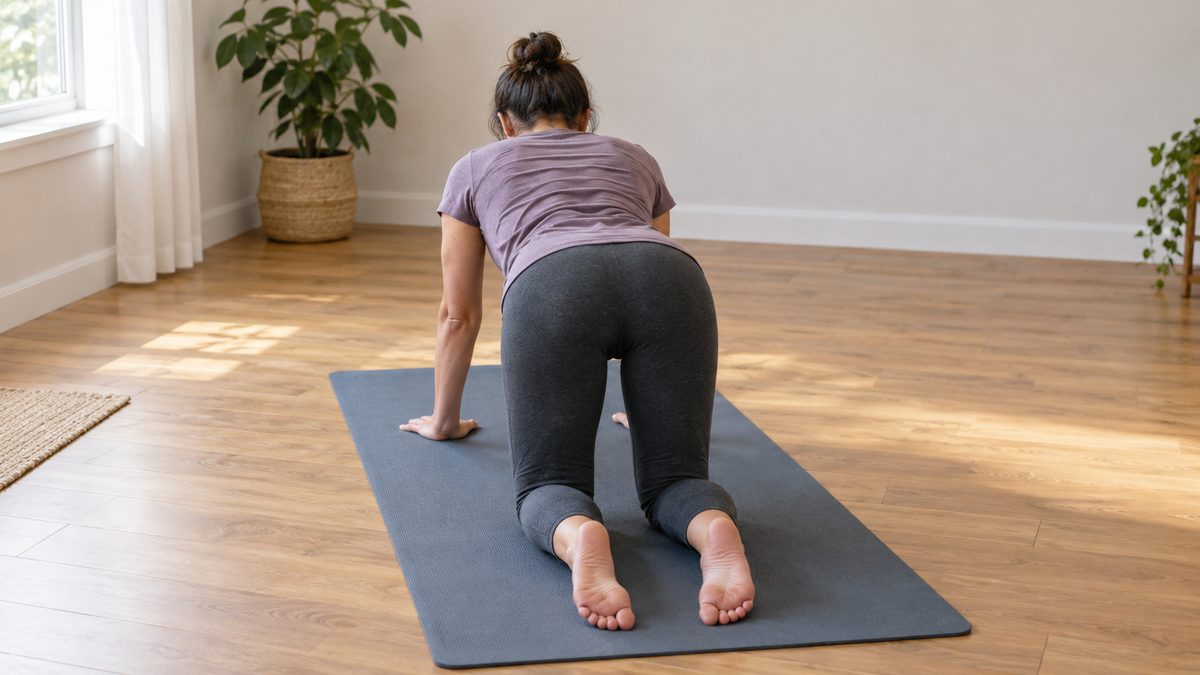
On hands and knees, place hands roughly below shoulders and knees roughly below hips. Gently round your back a small amount, then return towards a comfortable middle position. If comfortable, allow a small movement in the other direction without dropping into a deep arch.
Try four slow cycles. Keep your neck in line with the movement rather than throwing your head back. If wrists, knees or your back object, leave this pose out; padding does not make a painful position compulsory.
A shallow child's pose variation
From hands and knees, move your hips back a little towards your heels while keeping your hands supported. Stop well before any pulling or pinching. Your bottom does not need to reach your heels, and your forehead does not need to touch the floor.
Return after an easy breath or two rather than sinking into a long hold. Skip this option if kneeling or bending forwards worsens symptoms. For other low-demand options, see yoga movements for back stiffness.
Change the plan when a pose asks too much
| What feels difficult | What to try instead | When to stop |
|---|---|---|
| Pressure through wrists | Use supported sitting and gentle shoulder movement | Pain, tingling or weakness appears |
| Kneeling discomfort | Try a comfortable seated or lying option | Padding does not remove discomfort |
| Bending forwards feels worse | Omit child's pose and stay in an easy middle range | Pain spreads into a leg |
| Floor transfers feel unsteady | Practise from a stable chair with guidance | You cannot rise safely |
Deep forward folds, strong backbends and forceful twists are not necessary for a gentle session. Avoid bouncing into a stretch, holding your breath or letting another person push you farther. Being able to copy a photograph is not a measure of a suitable practice.
If you attend a class, tell the teacher about symptoms and medical restrictions before it starts. Explain that you may skip poses and take breaks. A teacher can adapt a class, but cannot rule out a medical cause for pain.
Judge the session by your response afterwards
Finish by returning to sitting and standing in stages, pausing if you feel light-headed. Notice how ordinary walking feels later and how you feel the next morning. A session that leaves symptoms worse needs reducing, changing or pausing rather than repeating at greater intensity.
Keep other comfortable activities available. A short walk may fit your day more easily than floor practice; see walking with back comfort in mind. For desk-based movement, the gentle posture exercise routine offers options that do not all require a mat.
Back pain warning signs override the yoga plan
Stop and seek medical advice for increasing pain, new tingling, numbness or weakness. Fever, feeling unwell with back pain or pain after a significant injury also needs assessment. Do not explain away persistent night pain or worsening symptoms as a need to stretch more.
Get emergency help for new difficulty passing urine, loss of bladder or bowel control, numbness around the genitals or bottom, or back pain with weakness or numbness in both legs. Read when to get medical help for back pain. For official general guidance, consult the NHS back pain advice.
Frequently asked questions
Is a heated yoga class a good place to start?
A room that feels uncomfortably hot can make a session harder to judge. Choose a setting where you can pause, drink and leave comfortably, and ask for guidance if heat or exercise affects a health condition.
Should I take pain relief just so I can reach a pose?
Do not use a deeper pose as the reason to change medication use. Follow the medicine instructions and your clinician or pharmacist's advice. Adapt the movement instead of chasing flexibility.
Can I use a follow-along video at home?
Choose one that allows pauses and simple alternatives, and stop it whenever needed. A video cannot assess your symptoms, so avoid treating its pace or pose depth as a requirement.
What if a pose is comfortable on one side only?
Do not force the other side to match. Omit the movement if it provokes symptoms, and discuss a persistent or new difference with a clinician, especially if it comes with weakness or numbness.