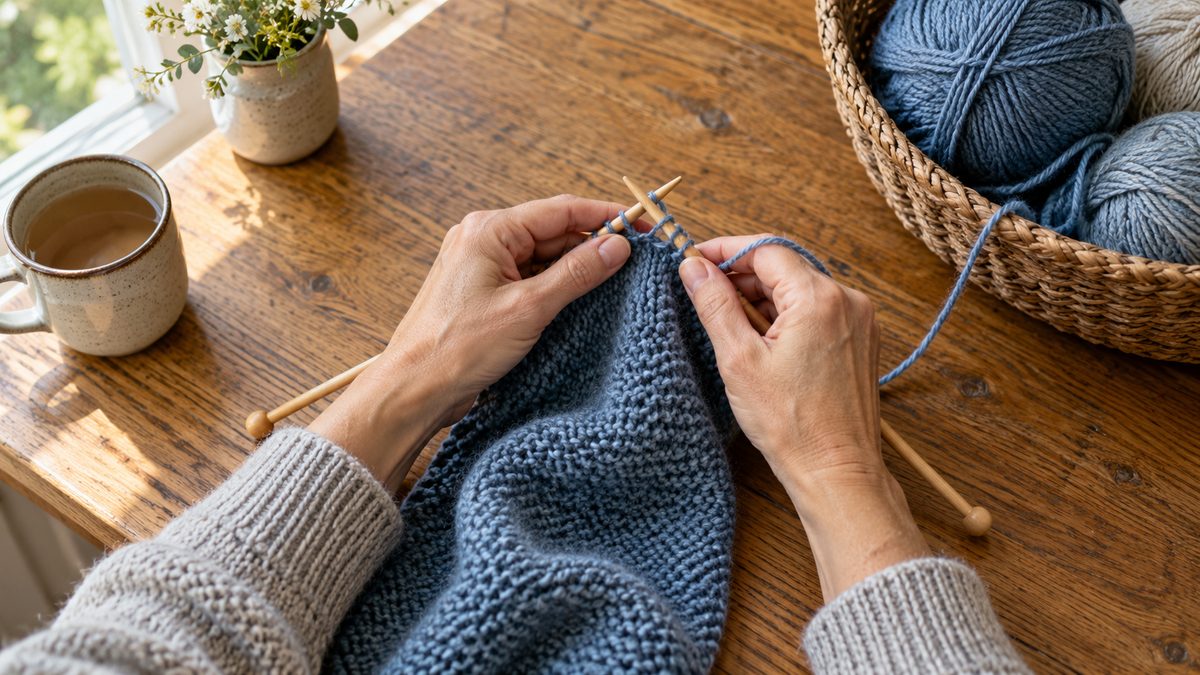
For more comfortable knitting or crafting, improve the light, bring the work within easy view and support your arms without lifting your shoulders. Change position regularly instead of trying to hold a perfectly straight back through a whole project.
Small stitches, dark yarn and a tricky pattern can draw your face towards your hands. When concentration takes over, you may keep that position long after it stops feeling comfortable. The setup should make relaxed work easier before you rely on reminders to sit differently.
Find out what makes you lean closer
Start a familiar task and notice where your head moves. If it drops forwards to see a stitch, test the lighting first. A nearby lamp should illuminate the work without shining into your eyes or casting your own hands into shadow.
For glossy materials, change the angle of the light to reduce glare. For dark or detailed work, a contrasting background may make edges easier to see. Keep cables away from walking routes and check that the lamp is stable.
If good lighting still leaves you straining to focus, consider an eye examination. Hunching may be a response to difficulty seeing, and a posture reminder will not address that. The guide to viewing height and distance offers related principles for keeping a pattern screen easy to read.
Arrange the chair and the work as a pair
Use a stable chair that allows your feet to rest securely. Sit back enough to use its support, then bring the work towards you. If the seat is too deep, a firm back cushion may help you reach the backrest while keeping your feet supported.
A soft sofa may feel inviting but can make it hard to support the arms and change position. If you use one, check that you are not sliding into a hollow or resting a shoulder against a high armrest. Put the work down before adjusting cushions.
Our signs that a chair does not suit you can help identify a setup problem. No particular chair style guarantees comfort; use your ability to reach, see and move as the test.
Give hands, elbows and shoulders separate support
| Craft task | Adjustment to try | Avoid |
|---|---|---|
| Knitting or crochet | Rest forearms lightly on a cushion if it helps | A cushion so high that shoulders stay raised |
| Drawing or detailed paper work | Move the work nearer; use a secure tilted surface if suitable | Balancing a board where it can slip |
| Reading a pattern | Place it ahead on a stable support | Repeatedly twisting to a sheet beside or behind you |
| Sorting materials | Keep frequently used items in a shallow nearby tray | Reaching to the floor for every colour or tool |
| Large fabric work | Support the spare fabric on the table or your lap | Letting its weight pull steadily through your hands |
Bringing work closer to your eyes should not mean holding your hands high in the air. Find a compromise where the view is clear and your shoulders settle. If the task cannot fit that arrangement, use shorter work periods or another surface.
Use a stopping point that protects the project too
Pick a natural pause, such as completing a row or section. Mark your place before standing so you do not feel obliged to keep working to avoid losing it. A gentle timer can remind you to check your body, but it need not dictate an exact schedule.
During the pause, release the tools, uncurl your fingers and walk a little if safe. Let your shoulders move comfortably instead of pulling hard on your neck. The upper back and neck movement guide covers gentle options; none should produce sharp or spreading symptoms.
For a long project, alternate close work with sorting or planning at a different height. Avoid replacing knitting with an equally long period looking down at a telephone. A change in hand activity does not always change the demand on your neck.
When a deadline makes every pause feel expensive
A gift deadline or unfinished order can keep you working after concentration fades. Decide in advance which parts can wait, be simplified or be shared. Pushing through a painful evening may make the next session more difficult to approach.
Keep materials organised so starting again is quick. Store the active project in a manageable container rather than a heavy bag that must be hauled from the floor. Put sharp tools away before you stand or leave the room.
If discomfort begins, change one feature first: the light, work height or arm support. That makes it easier to tell what helps. If several reasonable adjustments do not allow comfortable work, seek a clinician's assessment rather than repeatedly buying a different setup.
Know which symptoms need a professional assessment
This advice concerns general comfort. Get prompt medical help for numbness, weakness, fever, pain after a fall or injury, and pain that keeps getting worse. Loss of bladder or bowel control, numbness around the bottom or genitals, or marked new leg weakness requires emergency assessment.
Persistent hand tingling, reduced grip or pain spreading down an arm also warrants medical advice. Read the back pain warning signs guide for symptoms that should not be managed by changing a chair alone.
Frequently asked questions
Is a rocking chair suitable for knitting?
It may be comfortable if you can support your feet and arms and get up safely. Keep rocking movements gentle and materials out of the mechanism. If the chair makes you brace or slide forwards, use another seat.
Can I craft while watching television?
Keep the screen where you can glance up without repeatedly twisting your neck. Choose a simple task when your attention is divided. Detailed work may be easier to organise with fewer competing visual demands.
Should I keep my elbows against my ribs?
Let your upper arms rest comfortably rather than pinning them in place. Different crafts need different amounts of movement. Support should reduce unnecessary holding effort while still allowing your hands to work freely.
What if my craft requires leaning over briefly?
Brief leaning is part of many tasks. Bring the piece close, avoid adding a long reach and return to a supported position afterwards. It is the prolonged, unchanging position and your symptoms that should prompt an adjustment.